Best Portable Document Scanner for a Student Bag

Sheet-fed or wand? That single choice decides whether a portable scanner handles your handouts or your textbooks. Six models compared on published weight, dimensions, warranty and feed type, with the Epson ES-50 leading at 0.59 lb.

By Connor SmallUpdated 17 min read
On this page
- Best portable document scanner for students at a glance
- Sheet-fed or wand: which one suits your coursework?
- How I narrowed six portable scanners down
- 1. Epson Workforce ES-50 Compact & Lightweight Mobile — Best overall
- 2. Brother DS-640 Compact Mobile Document Scanner — Most versatile
- 3. Plustek Mobile Scanner S410 Plus — Best warranty
- 4. Canon imageFORMULA R10 — Best premium
- 5. Hczrc Portable Scanner — Best upgrade
- 6. AOZBZ Portable Document Scanner — Best budget pick
- How heavy is too heavy for a backpack?
- Does a portable document scanner need its own power?
- What the listings leave out
- When a different pick wins
- The verdict
- FAQ
The best portable document scanner for students is the Epson Workforce ES-50, a 0.59 lb sheet-fed unit measuring 1.3 x 1.8 x 10.7 in that draws power from your laptop's USB port. If your material is bound into textbooks or library books, the wand-style AOZBZ Portable Document Scanner is the better buy, because no sheet-fed scanner can take a page it cannot pull through a roller.
This category is not for everyone. If you only ever digitise a handout or two a term, your phone camera and a free scan app will do the job and cost you nothing. A dedicated scanner earns its space when you're feeding dozens of pages, want text you can search, or need a machine that doesn't produce a curved, shadowed page every time. Everyone else should stop here and save the money.
Best portable document scanner for students at a glance
| Pick | Feed type | Weight | Price |
|---|---|---|---|
Best overall Epson Workforce ES-50 |
Single-sheet fed | 0.59 lb | Check Price |
Most versatile Brother DS-640 |
Single-sheet fed | 1.03 lb | Check Price |
Best warranty Plustek Mobile Scanner S410 Plus |
Single-sheet fed | 0.9 lb | Check Price |
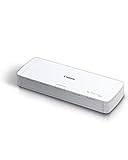
Best premium Canon imageFORMULA R10 |
20-sheet feeder, duplex | 2.2 lb | Check Price |
Best upgrade Hczrc Portable Scanner |
Handheld wand | 0.6 lb | Check Price |
Best budget pick AOZBZ Portable Document Scanner |
Handheld wand | 0.31 lb claim | Check Price |



Sheet-fed or wand: which one suits your coursework?
Every guide to the best portable document scanner for students compares resolution first. That is the wrong place to start. The wand models here advertise 900dpi and the sheet-fed models mostly don't publish a dpi figure at all, yet the sheet-fed units are the better tools for most coursework. Resolution is not what separates these machines. Feed mechanism is.
A sheet-fed scanner pulls a loose page through a slot. Four of the six picks work this way: the Epson ES-50, the Brother DS-640, the Plustek S410 Plus and the Canon R10. Feed it a handout, a printed essay, a receipt or an ID card and it comes out flat, square and consistent. Feed it a page that is glued into a spine and it does nothing at all.
A wand scanner is the opposite. The AOZBZ and the Hczrc are both handheld bars you drag down a page. Nothing is pulled anywhere, so a textbook, a hardback, a library book or a poster on a wall is fair game. The cost is that your hand controls the speed, and a wobble shows up as a skewed or streaked line.
So the question is short:
- Loose pages only? Sheet-fed. Faster, straighter, less fuss.
- Anything bound? Wand, or nothing.
- Both, often? Buy for the bound material, because sheet-fed work can fall back to a phone in a pinch and bound material cannot.
How I narrowed six portable scanners down
I set three criteria before looking at any product, weighted in this order.
- Feed type coverage, weighted heaviest. A shortlist of six sheet-fed scanners would be useless to anyone photocopying out of a reserve textbook, so the set had to include both mechanisms.
- Published weight and length, weighted second. This is a backpack purchase. I lined up the dimension figures from every listing and kept only units under about a foot long, which is why every pick here measures between 10 and 11.9 in on its longest side.
- Published warranty, weighted third. A stated warranty term is the one durability signal in listing data that isn't a marketing adjective. Two picks state a clear term, one states an exchange service, one says to contact the manufacturer, one lists a bare number and one publishes nothing.
Why those three, in that order? Because feed type decides whether the machine can do your work at all, size decides whether you'll actually carry it, and warranty is the tiebreak once the first two match. Resolution claims got no weight, since three of six listings publish no dpi figure and the ones that do are the cheapest units in the set.
1. Epson Workforce ES-50 Compact & Lightweight Mobile — Best overall
The lightest sheet-fed scanner here at 0.59 lb, and it needs nothing but a USB cable to run.
Best for: someone carrying a scanner to campus daily for loose handouts, notes and receipts Skip it if: you need to digitise pages out of bound textbooks
Two numbers make the case. The ES-50 weighs 0.59 lb, less than any other sheet-fed pick, and its body is 1.3 x 1.8 x 10.7 in, the shortest of the four fed units. It slides into a laptop sleeve rather than taking up a compartment. Epson also states it draws its power over USB 2.0 with no batteries and no external supply, which matters when you're working from a library carrel with one free socket already claimed by your laptop.
On paper handling, Epson claims documents up to 8.5 x 72 in, which covers letter-size lecture notes, ID cards and long receipts. The listing puts single-page speed as fast as 5.5 seconds and bundles Epson ScanSmart software for scanning, reviewing and saving in one pass. Treat those as the manufacturer's figures rather than measured ones.
Where it loses: this is a single-sheet-fed machine with no stack feeder, so a 30-page reading pack is 30 separate insertions. It's also the oldest design in the set, listed as released in 2017, and only one seller lists it. The warranty entry just says to contact the manufacturer, so you get no stated term at all.
Pros:
- Lightest sheet-fed pick at 0.59 lb
- Shortest fed body here, 10.7 in long
- USB-powered, no batteries or wall adapter
- Handles paper up to 8.5 x 72 in per Epson
- Bundled ScanSmart software for scan and save
Cons:
- One page at a time, no stack feeder
- No stated warranty term in the listing
- 2017 design, oldest in this set
- Only one seller lists it
- Cannot scan bound books at all
2. Brother DS-640 Compact Mobile Document Scanner — Most versatile
The fed pick with the widest software reach, sending scans to cloud, email and OCR destinations.

Best for: a student who wants scans landing straight in cloud storage rather than a local folder Skip it if: you want the smallest possible footprint in a full bag
At 1.03 lb and 1.4 x 11.9 x 2.2 in, the DS-640 is the longest of the fed picks, an inch and change more than the Epson. What you get for that is reach. Brother's free iPrint&Scan desktop app lists scan-to destinations including PC, network, cloud services, email and OCR, so a marked-up seminar reading can go to your drive without a manual file move. Brother also claims up to 16ppm with colour running at the same speed as black and white, and lists automatic colour detection, image rotation, background removal and text enhancement.
Power comes from the included micro USB 3.0 cable, so no outlet is required. It's the newest of the three slim fed units at 2020, and Brother states a 1-year limited warranty, which the Epson does not match. Two sellers stock it.
The trade-off is size against the Epson and price position: it sits in the most expensive tier of this six and asks nearly twice the Epson's weight for a scanner that still takes one sheet at a time. Its listing quotes a weight of about 1.5 lb in the feature text while the specification says 1.03 lb, so treat the marketing line with caution.
Pros:
- 1-year limited warranty stated
- Scan-to cloud, email and OCR destinations
- Micro USB 3.0 powered, no outlet needed
- Up to 16ppm claimed, colour at the same speed
- Newest of the three slim fed picks
Cons:
- Longest fed body here at 11.9 in
- Premium price tier for single-sheet feeding
- Feature text and specification disagree on weight
- No stack feeder despite the price position
3. Plustek Mobile Scanner S410 Plus — Best warranty
The only pick in this set with a stated 2-year manufacturer warranty.

Best for: a student on a multi-year course who wants the longest published cover Skip it if: you work on a Mac
Warranty is the reason this one is here. Every other pick publishes one year, an exchange service, a bare digit, or nothing; the S410 Plus states 2 year manufacturer. Across a three-year degree, that is the difference between cover for one year of your course and cover for two.
The rest holds up. It weighs 0.9 lb, lighter than the Brother, and measures 1.9 x 1.6 x 11.7 in. Plustek describes button-free scanning, where the unit detects a page, processes the image and saves it without you pressing anything, which is a genuinely useful behaviour when you're feeding a stack of handouts one after another. Paper handling covers Letter and Legal sizes plus business cards, plastic ID cards, invoices and receipts, and bundled Docaction OCR is claimed to turn scans into searchable PDF, Excel or Word files. Power is drawn from the bus, so no batteries.
The catch is stated plainly in the title: Windows 7 / 8 / 10 / 11. There is no Mac support listed, which rules it out for a large share of student laptops. It's also a 2021 design listed by a single seller, and it costs more than both wand picks while taking only loose sheets.
Pros:
- Longest published warranty here, 2 years
- 0.9 lb, second-lightest fed pick
- Button-free automatic scan and save
- Bundled OCR for searchable PDF, Word, Excel
- Handles Legal size, ID cards and receipts
Cons:
- Windows only, no Mac support listed
- Only one seller lists it
- Single-sheet feeding, no stack tray
- 11.7 in body, near the longest here
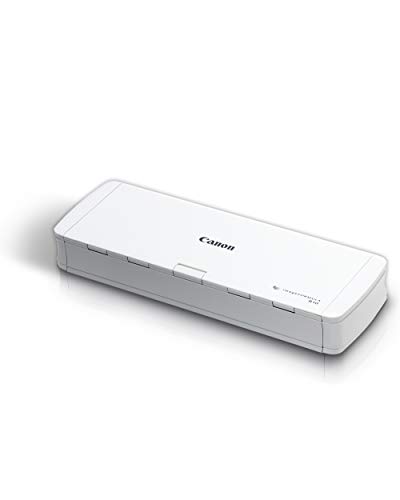
4. Canon imageFORMULA R10 — Best premium
The only pick with a 20-sheet feeder and double-sided scanning, which changes what a long reading pack costs you in time.
Best for: anyone digitising long double-sided reading packs or lab reports in one sitting Skip it if: you carry your bag all day and feel every extra pound
This is the outlier. Canon lists a 20 sheet feeder and duplex scanning at up to 12 pages per minute, so both sides of twenty pages go through without you touching them. Every other fed pick here takes one sheet at a time. For a 40-page double-sided reading pack, that's one load versus forty insertions.
You pay for it in bulk. At 2.2 lb it's nearly four times the Epson's weight, and 1.57 x 3.75 x 11.2 in makes it the thickest and widest body in the set. Canon states it handles receipts, business cards, plastic or embossed cards, reports and legal documents, works with Windows and Mac, and draws 2.5W or less with a 0.7W energy saving mode. The warranty is listed as one year with Advanced Exchange Service, and two sellers stock it.
Two honest marks against it. It's the most expensive pick here, and it's the slowest seller of the six by a wide margin, which suggests most shoppers are choosing lighter units. If your scanning is a handful of pages a week, the feeder is capacity you'll rarely use and weight you'll carry every day.
Pros:
- Only pick with a 20-sheet document feeder
- Duplex scanning, both sides in one pass
- Up to 12ppm claimed
- Windows and Mac support stated
- One year warranty with Advanced Exchange
Cons:
- Heaviest pick at 2.2 lb
- Thickest and widest body, 3.75 in deep
- Most expensive of the six
- Slowest seller in this set
- Cannot handle bound material
5. Hczrc Portable Scanner — Best upgrade
A wand that runs on two AA batteries and saves to its own SD card, so it works with no computer present.

Best for: copying pages out of reference books you can't take out of the library Skip it if: you want consistently straight, square scans without practice
This is the pick for material that will never go through a roller. Drag the 0.6 lb wand down a textbook page and the file lands on the included memory card, in JPEG or PDF, with 300dpi, 600dpi and 900dpi selectable. Hczrc states no software installation is required and no computer needs to be connected while you scan, which is exactly right for a reference shelf you can't remove books from.
Power is 2 AA batteries, not included, which is worth budgeting for. Body dimensions are 1.5 x 11 x 2 in and you pull files off later over USB, to a computer or a phone. It's the second-cheapest pick here and it's the more substantial of the two wands, with a stated weight where the AOZBZ publishes only a marketing figure. The warranty field reads simply "1" with no unit, so read it as unclear rather than as a year.
The real cost is consistency. Scan quality depends on how evenly your hand moves, and a rushed pass over a curved page near the spine will show it. There's no OCR mentioned, so text isn't searchable out of the box, and the listing names no supported operating systems for the file transfer.
Pros:
- Handles bound books, sheet-fed picks cannot
- 0.6 lb, lighter than every fed pick
- Runs on 2 AA batteries, no computer needed
- Saves to included memory card as JPEG or PDF
- Three resolutions up to 900dpi
Cons:
- Scan straightness depends on your hand
- Batteries not included
- Warranty listed only as "1", no unit
- No OCR or searchable text mentioned
- Only one seller lists it
6. AOZBZ Portable Document Scanner — Best budget pick
The cheapest of the six and the lightest thing here, with a 16G card included in the box.

Best for: a first-year testing whether they'll use a scanner at all before spending more Skip it if: you're on a recent Mac or need the operating system confirmed before buying
If your budget is the binding constraint, this is the entry point. It's the cheapest pick in the set, and AOZBZ describes it as about 0.31lb, which would make it the lightest here, though no weight appears in the published specification. Dimensions are 0.98 x 10 x 0.98 in, a slim silver bar shorter than any fed unit. A 16G SD card is included and cards up to 32GB are supported, with JPEG and PDF output and 300dpi, 600dpi or 900dpi modes.
Like the Hczrc, it scans bound material, which is the whole reason a wand belongs on this list. Operation is described as long-pressing the power switch, choosing colour mode and resolution, then pressing Scan and drawing the wand across the page.
The compatibility line is the problem. The listing names Windows 2000/ME/XP, which are long-dead versions, and says nothing about current Windows releases or macOS. Whether it works with your laptop is a question the listing does not answer. There's no published weight, no warranty term and no release year, making this the thinnest data set of the six, and wand scans carry the same hand-steadiness penalty as the Hczrc.
Pros:
- Cheapest pick in this set
- 16G SD card included, 32GB supported
- Scans bound books and hardbacks
- Three resolution modes up to 900dpi
- Slimmest body here at 0.98 in
Cons:
- Listed compatibility names only obsolete Windows versions
- No published weight, warranty or release year
- Scan quality depends on a steady hand
- No OCR or searchable output mentioned
How heavy is too heavy for a backpack?
A scanner you leave at home has no value, so weight deserves more attention than it usually gets. The published figures here span from 0.59 lb to 2.2 lb, a spread of well over a pound.
Some rough thresholds, drawn from these picks:
- Under 1 lb: the Epson at 0.59 lb, the Hczrc at 0.6 lb, the Plustek at 0.9 lb. These sit in a bag alongside a laptop without you thinking about them.
- Around 1 lb: the Brother at 1.03 lb. Noticeable in an already full bag, fine otherwise.
- Over 2 lb: the Canon at 2.2 lb. Fine for a desk-to-desk move or a scanning session at home, heavy for an all-day carry.
Length matters as much as mass. Every pick here is between 10 and 11.9 in on its longest side, which is roughly the width of a 13-inch laptop, so all six lie flat in a sleeve pocket. Depth is where the Canon separates: at 3.75 in it needs a compartment, while the Epson at 1.8 in slides into a slot. Check the shortest dimension against your bag, not the longest.
Does a portable document scanner need its own power?
Whether a portable document scanner needs its own power supply splits this set in two, and it changes where you can actually use one.
Four picks run off your computer. The Epson, Brother and Plustek listings all describe USB or bus power with no batteries and no external adapter. The Canon lists power consumption of 2.5W or less with a 0.7W energy saving mode. Plug into a laptop and you're scanning, which is ideal at a desk or in a library with a laptop open anyway.
The two wands are independent. The Hczrc takes 2 AA batteries, not included, and writes to its memory card. The AOZBZ writes to its included 16G card. Neither needs a computer connected at the moment of scanning, which is what makes them usable standing at a shelf.
The practical difference for the best portable document scanner for students comes down to where the scanning happens. Sitting down with your laptop, USB power is simpler and there's nothing to replace. Standing in the stacks with a book that can't leave the building, battery-plus-card is the only arrangement that works.
What the listings leave out
Read these six listings closely and the gaps are as informative as the specifications.
- Three of six publish no dpi figure. The Epson, Brother, Plustek and Canon listings talk about speed and software instead. The two wands lead with 900dpi. That inversion should tell you resolution isn't how the fed models compete.
- Warranty terms are inconsistent. Only the Plustek states a clear 2 year manufacturer term. Brother states 1-year limited, Canon states one year with an exchange service, the Epson says to contact the manufacturer, the Hczrc field reads "1" with no unit, and the AOZBZ publishes nothing.
- Operating system support is patchy. Epson and Canon state Windows and Mac. Plustek names Windows only. The AOZBZ names obsolete Windows releases. The Hczrc names none.
- Only the Canon publishes a page-capacity figure. Its 20 sheet feeder is stated; the other fed picks describe single-sheet operation.
- No scan-quality claim in this set has been independently measured. Speed and dpi figures are the manufacturers' own.
Ask the seller before you commit if the operating system answer isn't in the listing. On the two wand picks, that's the one thing I'd verify first.
When a different pick wins
Three thresholds flip the recommendation away from the Epson.
- You scan bound pages. Any textbook, hardback or library book that can't be unbound sends you to a wand. Take the Hczrc if you'll do it regularly and want a stated weight and battery operation; take the AOZBZ if you're testing the idea cheaply.
- You regularly scan more than about 20 pages in one sitting. That's the Canon's feeder capacity, and it's the point at which single-sheet insertion stops being a minor annoyance. Above it, the R10's duplex tray saves you real time even at 2.2 lb.
- You want cover for more than one year. Only the Plustek states 2 years. If your course runs three or four years and the machine is going in and out of a bag constantly, that term is worth the Windows-only restriction, assuming you're on Windows.
One more: if scans need to land in cloud storage automatically rather than a local folder, the Brother's listed scan-to destinations cover that and the Epson's software description does not.
The verdict
If you're carrying a scanner to campus for loose handouts, printed essays and receipts, buy the Epson Workforce ES-50. It's 0.59 lb and 10.7 in long, the smallest and lightest fed unit here, and it runs on USB power alone so it works wherever your laptop does. Nothing else in this set combines those two things.
If your material is bound, buy the Hczrc Portable Scanner. A sheet-fed scanner physically cannot take a page glued into a spine, and no amount of speed or software fixes that. The Hczrc runs on 2 AA batteries and saves to its own card, so it works standing at a library shelf with no computer, and at 0.6 lb it weighs almost exactly what the Epson does.
The cutoff between them is simple: can the page come out of the binding? Yes, and the Epson is faster, straighter and less dependent on a steady hand. No, and the Epson is useless to you.
Two conditions override both. Past 20 pages a sitting, the Canon imageFORMULA R10's duplex feeder is the only pick that saves you the labour, at the cost of 2.2 lb in the bag. And if you're on Windows and want the longest published cover, the Plustek S410 Plus is the only unit here stating a 2 year manufacturer warranty.
FAQ
Is a portable document scanner worth it for a student?
A portable document scanner is worth it if you're digitising pages weekly rather than occasionally. Feeding thirty handouts through the Epson ES-50 beats photographing each one, and you get flat, square pages instead of curved and shadowed ones. Scan a handful of sheets a term and your phone is genuinely enough. Volume and consistency are what justify the purchase, not novelty.
Which portable document scanner gives the most for the least money?
The most capability for the least money here is the AOZBZ Portable Document Scanner, the cheapest of the six, which includes a 16G SD card and scans bound books that no fed model can touch. The catch is thin published data: no weight, no warranty term, and compatibility listed only as Windows 2000/ME/XP. Verify your operating system works before committing.
Can a portable scanner handle a textbook page?
A portable scanner can handle a textbook page only if it's a handheld wand. The AOZBZ and Hczrc are dragged across the paper, so nothing needs to feed through rollers. The Epson, Brother, Plustek and Canon all pull loose sheets through a slot and cannot accept a bound page. Check the feed mechanism before anything else.
Epson ES-50 or Canon R10: which should I buy?
Between the Epson ES-50 and Canon R10, the deciding number is pages per session. The Epson takes one sheet at a time, weighs 0.59 lb and measures 1.3 in thick. The Canon has a 20 sheet feeder with duplex scanning at up to 12ppm claimed, but weighs 2.2 lb and is 3.75 in deep. Under twenty pages, take the Epson.
What mistake do first-time scanner buyers make?
The mistake first-time scanner buyers make is shopping on dpi. The two 900dpi models here are the cheapest in the set, while the fed units mostly publish no dpi figure and are better tools for coursework. Feed type, weight and stated operating system support decide whether a scanner actually does your work. Resolution barely enters into it.
Start with the honest question: does your material come loose, or does it stay in a binding? Answer that and the shortlist collapses to two or three picks, and the specifications above will settle it in a minute. For most students the Epson Workforce ES-50 is the right default because it asks the least of you, 0.59 lb in the bag and one cable to your laptop, and a tool that light is one you'll keep using in week ten as readily as week one. Anyone working out of books they can't take home should skip it and buy a wand instead.