Best Document Scanner by Speed, Size and Feed

Five scanners compared on published specifications: weight, footprint, feeder capacity and duplex ability. The Epson ES-50 leads for paper-light desks, with the ES-400 II taking over once stacks get thick.

By Connor SmallUpdated 15 min read
On this page
- Best document scanner for home office at a glance
- How I screened these five scanners
- Sheet-fed or flatbed: which one suits your paper?
- 1. Epson Workforce ES-50 Compact & Lightweight Mobile — Best overall
- 2. Epson Workforce ES-400 II High-Speed Color Duplex Desktop — Best premium
- 3. ScanSnap iX1300 Wireless or USB Double-Sided Color — Runner-up
- 4. Brother DS-640 Compact Mobile Document Scanner — Best for pros
- 5. Canon CanoScan LiDE 300 Scanner — Best budget pick
- How much desk space does each one need?
- Does "home office" mean anything on a spec sheet?
- What more money buys in this set
- The verdict
- FAQ
The best document scanner for home office use is the Epson Workforce ES-50, a 0.59 lb sheet-fed unit that Epson says clears a single page in as little as 5.5 seconds. If your paperwork arrives in stacks rather than singles, the Epson ES-400 II and its 50-sheet feeder is the better buy. Get this choice wrong and you don't lose money so much as time: a scanner that fits your desk but not your paper ends up in a drawer, and the filing pile keeps growing next to it.
Best document scanner for home office at a glance
| Pick | Feed type | Footprint & weight | Price |
|---|---|---|---|
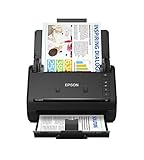
Best overall Epson Workforce ES-50 |
Single sheet 5.5 sec/page claim |
1.3 x 1.8 x 10.7 in 0.59 lb |
Check Price |
Best premium Epson Workforce ES-400 II |
50-sheet ADF, duplex | 6.9 x 6.6 x 11.6 in 8.16 lb |
Check Price |
Runner-up ScanSnap iX1300 |
Duplex feeder 30ppm claim |
3.3 x 11.7 x 4.5 in 4.4 lb |
Check Price |
Best for pros Brother DS-640 |
Single sheet 16ppm claim |
1.4 x 11.9 x 2.2 in 1.03 lb |
Check Price |
Best budget pick Canon CanoScan LiDE 300 |
Flatbed glass | 1.7 x 14.5 x 9.9 in 3.6 lb |
Check Price |



How I screened these five scanners
I set three criteria before looking at any product, and weighted them in this order.
- Feed mechanism, weighted heaviest. This is the one specification that cannot be worked around. A single-sheet scanner will never clear a 40-page contract quickly, and a flatbed will never do it at all without you lifting the lid 40 times.
- Footprint, weighted second. A home office desk is usually a desk that does other jobs too. I compared the published dimensions of every unit rather than the marketing word "compact", which appears in three of these five listings and means three different things.
- Published duplex capability, weighted third. Double-sided paperwork is common in household filing: bank statements, insurance documents, tax forms. Two of these five list duplex scanning explicitly.
Why those three and not resolution or software? Because resolution figures are not published in this data for any of the five, and the software bundles are broadly comparable in what they promise. Feed type, size and duplex are the three things a specification sheet actually settles. Everything else you'd be guessing at.
The set spans one flatbed and four sheet-fed units, across the whole price range from cheapest to most expensive. Release years run from 2017 to 2021.
Sheet-fed or flatbed: which one suits your paper?
This is the fork in the road, and most guides skip past it to talk about pages per minute. Pages per minute is meaningless if the machine can't accept your paper in the first place.
Sheet-fed scanners pull loose pages through a slot. Four of the five picks here work this way. They're fast, they're thin, and they handle receipts and ID cards well. The Epson ES-50 lists support for documents up to 8.5 x 72 in, which covers long register receipts. What sheet-fed units cannot do is a page in a bound book, a stapled set, or a creased original that might jam.
Flatbed scanners lay the page on glass under a lid. The Canon CanoScan LiDE 300 is the only one here, and its glass measures within a 14.5 x 9.9 in body. That handles a book page, a photo, a passport, a folded document that's been in a drawer since 2019. It also means one page at a time, by hand, every time.
Here's the trick with this decision: count the last twenty things you needed to scan. If more than fifteen were loose single-sided sheets, buy sheet-fed. If books, photos and fragile originals made the list more than twice, the flatbed earns its place regardless of speed.
1. Epson Workforce ES-50 Compact & Lightweight Mobile — Best overall
The lightest and slimmest pick in this set, and the one that asks least of your desk while still clearing a page in seconds.
Best for: a paper-light desk with occasional receipts, contracts and ID cards Skip it if: you scan more than a few pages at a time
At 0.59 lb, the ES-50 is under six-tenths the weight of the Brother DS-640 and roughly a fourteenth of the ES-400 II. Its body measures 1.3 x 1.8 x 10.7 in, the smallest cross-section of anything here. That matters more than it sounds. A scanner this size lives standing up behind a monitor and comes out when needed, which is the difference between using it and not.
Epson claims a single page in as little as 5.5 seconds, and lists paper handling up to 8.5 x 72 in for long receipts. Power comes from USB 2.0 alone, with the listing stating no batteries or external supply are needed. Fewer cables on a home desk is a real gain.
The trade-off against the rest of this set is blunt: no feeder and no stated duplex. Every page goes in by hand, one side at a time. It's also the oldest design here, released in 2017, and the only pick whose warranty entry reads "Contact Manufacturer" rather than a stated term. Against the ES-400 II it loses on throughput. Against the Canon it loses on bound originals. On sheer desk-friendliness it wins.
Pros:
- Lightest pick in the set at 0.59 lb
- Slimmest body here, 1.3 in deep
- 5.5-second single-page claim from Epson
- Handles paper up to 8.5 x 72 in
- USB-powered, no separate adapter listed
Cons:
- No document feeder, so every page is manual
- No duplex scanning stated in the listing
- Warranty listed only as "Contact Manufacturer"
- Oldest design in this group, from 2017
- Only one seller lists it
2. Epson Workforce ES-400 II High-Speed Color Duplex Desktop — Best premium
The only pick here with a stated 50-sheet feeder, which makes it the one machine in the group that can actually clear a filing backlog.

Best for: clearing filing-cabinet backlogs and double-sided paperwork Skip it if: your desk cannot spare a permanent 11.6-inch footprint
This is the most expensive pick here, and the specification that justifies it is the 50-sheet Auto Document Feeder. Load a stack, press once, walk away. Epson also lists duplex scanning, so double-sided statements come through in one pass instead of two.
The software story is the deepest in this set. Epson lists searchable PDF creation via OCR, conversion to editable Word and Excel files, automatic file naming, a TWAIN driver for document management systems, and direct sending to Dropbox, Evernote, Google Drive and OneDrive. For anyone whose household filing needs to be searchable later, that OCR line is the one to note.
The cost is physical. At 8.16 lb and 6.9 x 6.6 x 11.6 in, it's the heaviest and bulkiest thing here by a wide margin, and it isn't going in a bag. Warranty is a 1-year limited term in the U.S. and Canada, the same as most of the group rather than better. Against the ScanSnap iX1300 it gives up wireless connectivity entirely. Against the ES-50 it gives up any pretence of portability.
Pros:
- 50-sheet automatic feeder, the only one stated here
- Duplex scanning for double-sided paperwork
- OCR for searchable PDFs, plus Word and Excel output
- TWAIN driver for document management software
- Direct upload to major cloud services
Cons:
- Heaviest pick at 8.16 lb
- Largest footprint here, 11.6 in long
- No wireless option, unlike the ScanSnap
- Highest price position in this set
3. ScanSnap iX1300 Wireless or USB Double-Sided Color — Runner-up
The only pick here that scans over Wi-Fi and can run without a computer attached at all.

Best for: scanning from a phone or laptop without a cable Skip it if: a wired USB scanner would do the same job
Connectivity is what sets this one apart. ScanSnap lists both USB and Wi-Fi, sending to Mac, PC, mobile devices and cloud services, with Chromebook support through the mobile app and the ability to be used without a computer. Nothing else in this group offers that. If your paperwork arrives on your phone as often as on paper, this is the pick that meets you there.
The listing claims up to 30ppm duplex scanning from a single touch, with automatic de-skew, colour optimisation and blank page removal. ScanSnap also describes a space-saving design meant to free up desk area even while scanning, and states it handles thick items and plastic cards.
At 4.4 lb and 3.3 x 11.7 x 4.5 in, it sits between the slot-fed pair and the ES-400 II. That's the sensible middle, but it's also the compromise. It carries a premium price position without the ES-400 II's stated 50-sheet feeder capacity, and its warranty is a 1-Year Depot term, meaning shipping it away rather than a local exchange. Buyers pick it less often than any other scanner here.
Pros:
- Wi-Fi and USB connectivity, unique in this set
- Runs without a computer connected
- Up to 30ppm duplex scanning claim
- Handles thick items and plastic cards
- Blank page removal and auto de-skew listed
Cons:
- Slowest seller of the five
- No stated feeder capacity to compare against the ES-400 II
- 1-Year Depot warranty means shipping for service
- Premium price position, 4.4 lb weight
4. Brother DS-640 Compact Mobile Document Scanner — Best for pros
A slot-fed scanner that claims identical colour and mono speeds, which matters if your work is invoices and forms rather than plain text.

Best for: working between a home desk and client sites Skip it if: you need a stated multi-page feeder
Brother makes one claim here that no other listing does: colour scanning runs at the same speed as black and white, up to 16ppm. For anyone digitising colour-coded forms, signed contracts or receipts with printed logos, that removes the usual penalty for scanning in colour.
Weight is 1.03 lb and the body is 1.4 x 11.9 x 2.2 in. That's fractionally heavier and longer than the ES-50, but still packs flat into a laptop sleeve. Power arrives over an included micro USB 3.0 cable, and Brother notes it works where there's no outlet. The free iPrint&Scan desktop app lists scan-to destinations covering PC, network, cloud, email and OCR, plus automatic colour detection, bleed-through prevention, text enhancement and colour drop.
It is the newer of the two slot-fed picks, released in 2020, and it publishes a 1-year limited warranty where the ES-50 does not. Both of those are real advantages. The catch is the same as the ES-50's: single-sheet only, no stated duplex, so double-sided pages need two passes. It also sits a step up in price from the ES-50 for a broadly similar mechanism.
Pros:
- Colour speed matches mono, up to 16ppm claim
- 1-year limited warranty stated
- 1.03 lb and 1.4 in deep, packs flat
- Micro USB 3.0 powered, no outlet needed
- Text enhancement and bleed-through prevention listed
Cons:
- Single-sheet feed only, no stack loading
- No duplex scanning stated
- Costs more than the lighter Epson ES-50
- Longer body than the ES-50 at 11.9 in
5. Canon CanoScan LiDE 300 Scanner — Best budget pick
The cheapest pick here and the only flatbed, which makes it the only one that can scan a page without pulling it through rollers.

Best for: bound pages, photos, passports and fragile originals Skip it if: you have stacks of loose paper to digitise
The Canon is the cheapest of the five and the only one in the flatbed and photo scanner category rather than document scanners. That category difference is the whole point. A lid and a glass bed mean you can scan a book page, an old photograph, a creased tax form or an ID document without risking a jam. Canon lists an Auto Scan Mode that detects what you're scanning, plus PDF, copy and send functions, over USB.
At 3.6 lb and 1.7 x 14.5 x 9.9 in, it's flatter than the ES-400 II but takes up far more desk surface than anything else here. It's a device you leave out, not one you tuck away. It also carries a 1-Year Limited Warranty, which puts it level with most of the set on cover despite the lowest price position.
The honest weakness is throughput. There's no feeder, no duplex, and no published speed figure at all in this listing, so a 30-page double-sided document means 60 separate lid lifts. Its feature list is also the thinnest of the five, with no OCR, cloud or wireless capability stated. Buyers do choose it more often than the rest of this group, which fits its role: the affordable second scanner rather than the workhorse.
Pros:
- Cheapest of the five picks
- Only flatbed here, handles books and photos
- Auto Scan Mode detects the original type
- 1-Year Limited Warranty stated
- The one buyers choose most often in this set
Cons:
- No feeder, so every page is placed by hand
- No duplex scanning
- No scan speed figure published in the listing
- Largest desk surface area of any pick, 14.5 x 9.9 in
- Thinnest feature list here, no OCR or cloud stated
How much desk space does each one need?
Worth doing before you buy: measure the clear space beside your keyboard. Then check these numbers.
- Epson ES-50 — 1.3 x 1.8 x 10.7 in. Stands on end behind a monitor. Effectively zero permanent footprint.
- Brother DS-640 — 1.4 x 11.9 x 2.2 in. Same idea, slightly longer.
- ScanSnap iX1300 — 3.3 x 11.7 x 4.5 in. Needs a corner, and ScanSnap claims the design keeps desk area free while scanning.
- Canon LiDE 300 — 1.7 x 14.5 x 9.9 in. Flat but wide. Roughly the area of a sheet of paper plus a margin.
- Epson ES-400 II — 6.9 x 6.6 x 11.6 in. A permanent resident, and 8.16 lb of it.
Weight tells you the second half of the story. Under about 1.5 lb, a scanner is something you carry. Over about 4 lb, it stays put. That single threshold separates the ES-50 and DS-640 from the iX1300, LiDE 300 and ES-400 II, and it's the most useful line to draw across the whole set.
Does "home office" mean anything on a spec sheet?
No, and it's worth being straight about that. "Home office" is how you describe a room, not a specification any manufacturer certifies. Only the ES-400 II listing uses the phrase at all, saying it's designed for home and office documents. So nothing here can be claimed to be purpose-built for your spare bedroom.
What you can judge for yourself is the three things that make a scanner survive in a shared domestic space:
- Does it need a mains adapter? The ES-50 and DS-640 both state USB power only. That's one less brick under the desk.
- Can it be put away? Anything under 1.5 lb and 2.2 in deep goes in a drawer between uses.
- Does it need a computer running? Only the iX1300 states it can be used without one.
Judge the modifier by those three questions rather than by any label on the box. A scanner that meets all three fits a home office. One that fails all three is an office machine that happens to be at your house.
What more money buys in this set
Moving up the price ladder here buys throughput, not image quality, because no resolution figures are published for any pick.
At the cheapest end, the Canon LiDE 300 buys you versatility of original: books, photos, cards. The ES-50 sits just above it and swaps that versatility for speed and portability, adding a 5.5-second page claim and long-receipt support.
The Brother DS-640 costs more again and adds a stated warranty, a 2020 design and the 16ppm colour-equals-mono claim. Then comes a jump. The ScanSnap iX1300 buys wireless and computer-free operation. The ES-400 II, the most expensive here, buys the 50-sheet feeder, duplex and the OCR-to-Word-and-Excel pipeline.
The pattern: money buys automation. Every step up removes something you'd otherwise do by hand.
The verdict
The Epson Workforce ES-50 is the best document scanner for home office use for most people, because at 0.59 lb and 1.3 in deep it's the only pick here that genuinely disappears when you're done with it, while still clearing a page in Epson's claimed 5.5 seconds. A scanner you can reach for in five seconds gets used. One you have to make room for does not.
Two conditions flip that. First, volume. If you're facing a filing cabinet rather than a to-do tray, the ES-400 II and its 50-sheet feeder plus duplex scanning does in one pass what the ES-50 needs a hundred manual insertions to do. The cutoff is roughly ten pages at a sitting: below it, hand-feeding is fine; above it, you'll resent it. Second, original type. Bound books, photos and fragile paper cannot go through a slot, so the Canon LiDE 300 becomes the only workable pick.
The ES-400 II's exact advantage over the ES-50 is stated duplex and a 50-sheet stack, nothing more mysterious than that. It costs you 8.16 lb of permanent desk space and the highest price position in this group. Decide by counting your pages, not by comparing speeds.
FAQ
Is a document scanner worth it for a home office?
A document scanner is worth it for a home office if you handle paper weekly rather than monthly. The gain is searchability, not tidiness. The Epson ES-400 II lists OCR that turns scans into searchable PDFs and editable Word or Excel files, which is what makes a digital pile genuinely better than a physical one. Occasional scanning is fine on a phone camera.
What's the cheapest way into document scanning here?
The cheapest way into this set is the Canon CanoScan LiDE 300, the lowest price position of the five and the only flatbed. It carries a 1-Year Limited Warranty despite that position, and Canon lists Auto Scan Mode, PDF creation, copy and send over USB. The catch is no feeder and no published speed figure, so every page is manual.
Do I need duplex scanning at home?
You need duplex scanning at home if your filing includes bank statements, insurance policies or tax forms, all of which print on both sides. Two picks here state it: the ES-400 II and the ScanSnap iX1300, the latter claiming up to 30ppm duplex. Without it, a 20-page double-sided document becomes 40 passes. That's the whole argument.
Epson ES-50 or Brother DS-640: which slot-fed scanner wins?
Between the Epson ES-50 and Brother DS-640, the Epson wins on size and cost: 0.59 lb against 1.03 lb, and a lower price position. The Brother answers with a stated 1-year limited warranty, a 2020 release rather than 2017, and a claim that colour scans run at the same 16ppm as mono. Pick Brother if colour volume matters.
What mistake do people make choosing the best document scanner for home office use?
The common mistake with the best document scanner for home office setups is buying on pages per minute before checking feed type. A 30ppm sheet-fed scanner cannot touch a bound book, and a flatbed cannot clear a 50-page stack at any speed. Count what you actually scan first. Then the speed figures start to mean something.
Pull the last twenty documents you needed digitised out of your memory and sort them into two piles: loose sheets and everything else. If loose sheets win by a mile and the pile is small, order the ES-50 and put it behind your monitor tonight. If the piles are thick and double-sided, the ES-400 II is worth its desk space. The reason the ES-50 stays the default is unglamorous: it's the only scanner here light enough that using it never feels like a chore, and a scanner you actually reach for beats a faster one you don't.