Best Portable PC Fans for Writers by Airflow

A writer needs a fan that cools a laptop without drowning out the keyboard. Seven portable USB fans, ranked by what actually matters at a desk.

By Connor SmallUpdated 18 min read
On this page
- How I screened these portable PC fans
- Best portable PC fans for writers at a glance
- Does 'for writers' actually mean anything here?
- What decides a quiet desk fan: noise, size, speed control
- 1. GSCOLER X1 USB Cooling Fan — Best overall
- 2. Gaiatop USB Desk Fan — Best budget pick
- 3. Honbay 4PCS Mini Mobile Portable USB Cooling Fan — Runner-up
- 4. SCCCF Quiet 80mm USB Fan — Best upgrade
- 5. ELUTENG 120mm Fan With 3 Speed 5V USB Powered Case Fan — Best minimal setup
- 6. SCCCF Quiet 120mm USB Fan — Best for pros
- 7. aceyoon 120mm USB Fan — Best premium
- How loud is 18dB at a keyboard, really?
- USB power: what your laptop can actually run
- What the listings do not tell you
- The verdict
- FAQ
The best portable PC fans for writers are led by the GSCOLER X1 USB Cooling Fan, a 120mm USB unit the brand rates at 18dB and 55.8 CFM, quiet enough to sit next to a keyboard without competing with the typing. The Gaiatop USB Desk Fan is the alternate pick if you want a 7.83 oz travel fan that goes in a bag and points air at your face, not your laptop.
How I screened these portable PC fans
I lined up the seven listings against three questions a writer actually asks: how loud is it near a keyboard, how portable is it in practice, and can I control the airflow when the room warms up. Everything else is decoration.
Two figures did most of the work. Frame size, because a 120mm blade moves the same air more slowly and quietly than an 80mm blade. And published noise, because a fan that whispers on paper still whispers on the desk. Only two picks state a decibel figure: the GSCOLER at 18dB, and ELUTENG at 23dB on its low setting. That gap is small on paper and audible in a quiet room.
Speed control mattered next. Four picks list a three-speed switch: SCCCF's 80mm, ELUTENG, aceyoon, and SCCCF's 120mm. The GSCOLER runs at a fixed 850 RPM. If you want to lower the noise further at night, a speed switch is the way to do it.
Bearing life is a durability proxy the listings actually publish. Both SCCCF fans claim 65,000-hour double ball bearings. ELUTENG and aceyoon claim 45,000 hours. The GSCOLER and the two desk-style fans do not publish a bearing rating.
Two picks were cut from the winner's slot on shape alone. The Gaiatop and Honbay are personal cooling fans that blow air at you, not at your machine. Useful, but a different job.
Best portable PC fans for writers at a glance
| Pick | Frame / form | Noise (claim) | Price |
|---|---|---|---|
Best overall GSCOLER X1 USB Cooling Fan |
120mm case fan 5.44 oz |
18dB fixed | Check Price |
Best budget pick Gaiatop USB Desk Fan |
5.5 in desk fan 7.83 oz |
3 speeds, no dB claim | Check Price |
Runner-up Honbay 4PCS Mini USB Cooling Fan |
Gooseneck, 4 pack 6.97 oz |
Not listed | Check Price |
Best upgrade SCCCF Quiet 80mm USB Fan |
80mm case fan 3.64 x 3.64 in |
3 speeds, no dB claim | Check Price |
Best minimal setup ELUTENG 120mm USB Case Fan |
120mm case fan 22.7 g |
23dB low claim | Check Price |
Best for pros SCCCF Quiet 120mm USB Fan |
120mm case fan 0.62 lb |
3 speeds, no dB claim | Check Price |
Best premium aceyoon 120mm USB Fan |
120mm case fan | 3 speeds, no dB claim | Check Price |



Does 'for writers' actually mean anything here?
Honest answer: not directly. None of these listings is marketed to writers, and Amazon's search treated the phrase as a soft filter, not a hard one. So the best portable PC fans for writers is a category you have to build yourself, from features writers actually care about.
Three things separate a writer's ideal fan from a gamer's:
- Noise near the keyboard. A writer types for hours. A fan that hums at 30dB will bury a mechanical keyboard's own noise floor and pull your attention away from the sentence.
- A frame that sits under, beside, or behind a laptop. Writers work on laptops more than towers. A slim 1.81-inch case fan tucks under a laptop stand; a 5.5-inch desk fan sits behind the screen.
- USB power, no wall wart. A writer moves. Every pick here runs from a USB port, so a power bank in a bag keeps the fan running at a café.
The GSCOLER wins on the first count outright. Its rated 18dB is the lowest published figure in the set, and the second-lowest, ELUTENG's 23dB, is roughly three times louder in a technical sense on the decibel scale. Take those numbers as the manufacturer's claims. They still line up in the same order your ears would rank them.
What decides a quiet desk fan: noise, size, speed control
Most portable fan guides compare price and RPM. Neither decides this.
The deciding specification is the pairing of frame size with published noise. A 120mm frame at 850 RPM moves the same volume of air as an 80mm frame spinning much faster, and it does so more quietly, because larger blades displace air with less turbulence. That is why five of the seven picks here are 120mm, and why the GSCOLER's 18dB figure is credible for a 120mm frame at a modest 850 RPM.
Speed control is the second lever. A three-speed switch is not just about "more air"; it is about turning the fan down further for late-night writing when the house is quiet. Four picks give you that switch: SCCCF's 80mm, ELUTENG, aceyoon, and SCCCF's 120mm. The GSCOLER does not.
Airflow figures are only supplied for the GSCOLER, at 55.8 CFM. The other picks describe airflow qualitatively. That makes side-by-side comparison awkward and it is one reason the GSCOLER's published data is the strongest in the set.
A quick shortlist by writing scenario:
- Silent room, laptop on a stand. GSCOLER X1, at 18dB and 5.44 oz.
- Noisy café, cooling yourself not the laptop. Gaiatop USB Desk Fan, three speeds, 7.83 oz.
- Tiny desk, no room for 120mm. SCCCF Quiet 80mm.
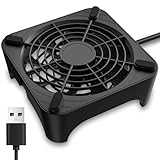
1. GSCOLER X1 USB Cooling Fan — Best overall
A 120mm USB fan the brand rates at 18dB, which is the lowest published noise figure in this set and the reason it leads.
Best for: a writer who wants the quietest 120mm option on a shared desk Skip it if: you need adjustable speed or a metal grill
Two things separate the X1 from the other four 120mm picks. It publishes a decibel figure, and that figure, 18dB, is roughly five below ELUTENG's stated 23dB on low. It also publishes an airflow number, 55.8 CFM, that none of the other 120mm fans list. GSCOLER says the fan spins at 850 RPM ±10%, which is on the slow side for a 120mm frame, and slow is exactly what a writer wants.
The integrated 530mm USB cable is a small kindness. Every other pick here uses USB too, but a captive cable means no fiddling with a loose lead behind a laptop. The frame measures 1.91 x 5.12 x 5.24 in and weighs 5.44 oz, so it slips into a backpack pocket without ceremony. GSCOLER states a 2-year manufacturer warranty, the only warranty published across the seven listings.
The trade-off is fixed speed. If you want to tone the fan down further after midnight, you cannot. The other 120mm picks let you.
Pros:
- Lowest published noise in this set at 18dB
- Only pick with a stated CFM figure, 55.8
- Integrated 530mm USB cable, no separate lead
- 2-year warranty, the only warranty here
- Sits flat under a laptop stand at 1.91 in tall
Cons:
- No speed controller
- ABS grill rather than metal
- Fixed 850 RPM, no low-noise setting to fall back to
2. Gaiatop USB Desk Fan — Best budget pick
A 5.5-inch personal desk fan with three speeds, the cheapest of the seven and the one that actually travels.

Best for: portable use in a bag between coffee shops Skip it if: you want a fan that sits flat under a laptop
The Gaiatop plays a different game from the 120mm case fans. It is a small personal fan, 5.9 x 2.2 x 5.5 in and 7.83 oz, that tilts 90° and points air at your face. If you write in cafés, that is exactly the fan you want, because the ambient noise is already high and the reason you want a fan is to stop feeling hot, not to cool a PS5.
Three speeds. The listing lays them out as Speed 1 at 3.1 m/s and 1500 RPM, Speed 2 at 4.0 m/s and 2000 RPM, and a stronger Speed 3. The base has four rubber pads, so it does not walk across a wobbly café table. USB power means a power bank keeps it running.
The trade-off is what it does not do. Airflow points forward, not down, so it is not a laptop cooler. And no decibel figure is published, so pair it with the 120mm picks if silence matters more than portability.
Pros:
- Cheapest of the seven picks
- Three speeds with published RPM values
- 90° tilt for aiming airflow
- Light at 7.83 oz for a bag
- Rubber pads reduce vibration on a shared desk
Cons:
- No published decibel figure
- Not designed to sit under a laptop
- Points air at the writer, not the machine
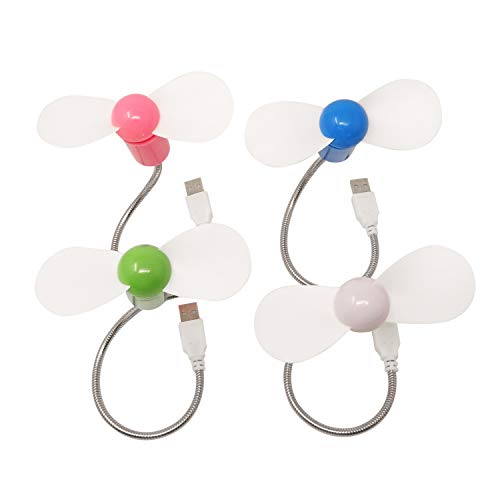
3. Honbay 4PCS Mini Mobile Portable USB Cooling Fan — Runner-up
Four gooseneck USB fans in a pack, the second-cheapest here and the most flexible for aiming air.
Best for: aiming airflow at a specific hot spot with a gooseneck Skip it if: you want strong, room-filling airflow
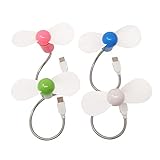
The Honbay is the only multi-pack in the set. Four fans, four colours: white, pink, blue, and green per the listing. The gooseneck is what makes them useful for a writer. You can point a small fan at the underside of a laptop where the vents are, and leave your desk fan free to point at your face. Or run one at a partner's desk, one at yours, and keep two spare.
Each fan measures 12.1 x 3.94 x 1.06 in and the pack weighs 6.97 oz total. Plastic and metal construction, USB powered, no speed switch. That last point matters: this is a single-speed accent fan, not a primary cooler.
The trade-off against the 120mm picks is real. Small blades on a flexible neck cannot move the volume of air a 120mm frame moves. Treat these as precision tools, not the main cooling for a hot laptop. As a runner-up, the Honbay earns its place by being the only pick that lets you cool multiple points at once, and by the price position that makes buying four fans not-punishing.
Pros:
- Four fans per pack, one of each colour
- Flexible gooseneck aims airflow precisely
- Second-cheapest pick in the set
- USB powered, works from a power bank
- Slim 1.06 in profile fits into narrow gaps
Cons:
- Single speed, no controller
- No published noise or CFM figures
- Small blades move less air than 120mm picks
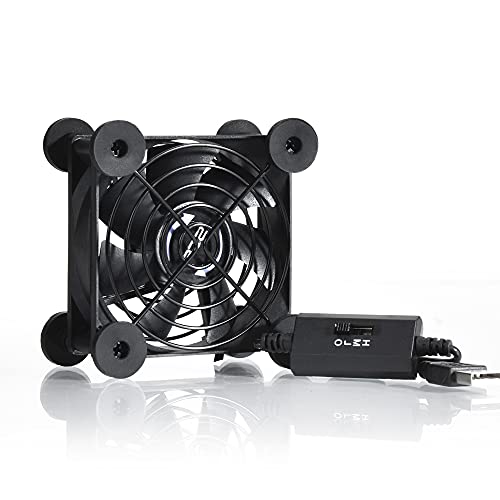
4. SCCCF Quiet 80mm USB Fan — Best upgrade
An 80mm case fan with three speeds and a claimed 65,000-hour bearing, the pick when a 120mm frame will not fit.
Best for: cramped desks where 120mm will not fit Skip it if: you need to cool a 15-inch laptop base
The 80mm SCCCF is the smallest case-style fan here, at 3.64 x 3.64 x 1.81 in. That is the point. Behind a router, under a receiver, or beside a mini PC on a crowded shelf, 120mm frames simply do not fit. The 80mm does.
SCCCF lists a 65,000-hour double ball bearing, the same bearing rating it applies to its 120mm sibling and higher than the 45,000-hour figure ELUTENG and aceyoon publish. Bearing hours are a durability claim, not a measured lifespan, but the ordering is consistent across listings. The 7-blade impeller and three-speed controller let you drop the noise floor at night, and iron grills on both faces protect the blades and cables.
The trade-off is airflow area. An 80mm frame moves less air than a 120mm at similar RPM, and the SCCCF does not publish a CFM figure. For a writer with a laptop on a stand, a 120mm is the safer buy. For a writer with a mini-PC tucked into a cabinet, this is the right shape.
Pros:
- Fits spaces a 120mm cannot
- Three-speed controller for late-night lowering
- 65,000-hour bearing claim
- Iron grill on both sides
- Foot pads allow flat or upright mounting
Cons:
- Smaller frame moves less air than 120mm picks
- No published decibel or CFM figures
- No stated warranty
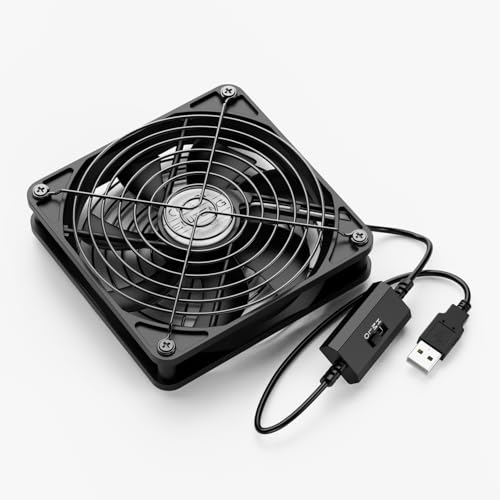
5. ELUTENG 120mm Fan With 3 Speed 5V USB Powered Case Fan — Best minimal setup
A 120mm three-speed fan the brand rates at 23dB on low, the lightest 120mm here at 22.7 g on paper.
Best for: a writer who wants three speeds and a slim, light frame Skip it if: you want a published warranty
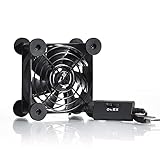
Two 120mm fans in this set publish a decibel number: the GSCOLER at 18dB and the ELUTENG at 23dB on its low setting. The ELUTENG is the only 120mm pick that combines a published low-speed dB claim with a three-speed switch, which is genuinely useful. You get the airflow of a 120mm frame with the option to drop it further when the room quiets.
Dimensions are 4.8 x 4.8 x 1.2 in, so it is slimmer than the GSCOLER's 1.91 in depth. The listing rates the dual ball bearing at 45,000 hours, less than SCCCF's 65,000 but still substantial. Aluminum grills on both faces, and it can lay flat or stand upright depending on where you park it.
The trade-off is documentation. No warranty is published, no weight beyond the listed 22.7 g figure that looks low for a 120mm frame, and no CFM. That is why it sits mid-pack rather than at the top: fewer numbers to check than the GSCOLER carries.
Pros:
- Three speeds with a 23dB low claim
- 45,000-hour dual ball bearing claim
- Slim 1.2 in depth for tight spots
- Aluminum grills on both faces
- Flat or upright placement
Cons:
- No stated warranty
- No CFM figure
- Higher price position than the GSCOLER
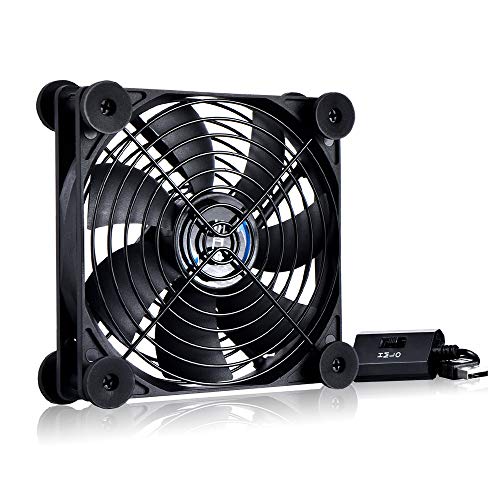
6. SCCCF Quiet 120mm USB Fan — Best for pros
The 120mm sibling of the 80mm SCCCF, with a 65,000-hour bearing claim and three-speed control for long writing sessions.
Best for: a long-hours setup that leans on 65,000-hour bearings Skip it if: you want the lightest 120mm option here
If you write eight hours a day and want the longest bearing claim you can point at, the 120mm SCCCF is the pick. Its listed 65,000-hour double ball bearing is the highest in the set, matched only by its 80mm sibling. Bearing hours are a manufacturer claim, but a fan that runs eight hours a day for years is exactly the case where the claim matters.
Frame is 4.92 x 4.92 x 1.81 in and 0.62 lb, heavier than the ELUTENG and the GSCOLER. Three-speed controller for adjusting the noise floor, iron grill on both faces, shockproof foot pads that let it lay flat or upright. Same 7-blade design as the 80mm.
Against the GSCOLER's 18dB figure, this pick does not publish a decibel number, so on paper the GSCOLER is quieter. Against the ELUTENG, it publishes a longer bearing life. That is the trade you make between the two 120mm three-speed picks.
Pros:
- 65,000-hour bearing claim, longest in set
- Three-speed multi-speed controller
- Iron grill on both faces
- Shockproof foot pads for flat or upright use
- 120mm airflow area
Cons:
- No published decibel figure
- Heaviest 120mm at 0.62 lb
- Higher price position than lighter picks
7. aceyoon 120mm USB Fan — Best premium
A white-finish 120mm USB fan with three speeds and a 45,000-hour bearing claim, the highest price position in the set.

Best for: a white desk aesthetic with speed control Skip it if: you want more published specifications before you buy
The aceyoon is the most expensive pick here. What you get for that position is a white finish that suits a light desk setup, three speeds, and a claimed 45,000-hour dual ball bearing. Aluminum grills on both faces protect the blades. It can sit flat or stand upright.
Here is where the aceyoon loses ground on the spec sheet. The listing publishes fewer figures than every other pick in this roundup. No weight. No exact dimensions beyond the 120mm frame. No decibel claim. No CFM. For a 120mm three-speed fan at the highest price position in this set, that thinness is what holds it back. You are buying on brand feel and colour more than on measurable difference.
If white matters and speed control matters, this is the pick. If you want the numbers that let you compare quietly, the GSCOLER, the ELUTENG, or either SCCCF publishes more.
Pros:
- White finish for aesthetic-focused setups
- Three-speed controller
- 45,000-hour dual ball bearing claim
- Aluminum grills on both faces
- Flat or upright placement
Cons:
- Fewest published specifications in the set
- Highest price position for no extra published capability
- No decibel or CFM figures
- No stated warranty
How loud is 18dB at a keyboard, really?
18dB is the noise floor of a very quiet bedroom at night. A rustle of paper sits somewhere near 20 to 25dB. Normal breathing measured close to the ear sits around 10dB. So a fan rated at 18dB, running 12 inches from a keyboard, will register to a writer as present but not distracting: quieter than the writer's own typing on almost any keyboard.
That is the GSCOLER's claim. Take it as a manufacturer figure, not a measurement in your room. Ambient noise, reflections off a hard desk, and how the fan is mounted all shift the perceived level. But the point stands: on paper, this is the quietest fan in the roundup, and it is quieter by a meaningful margin.
The ELUTENG's 23dB claim, its low-speed figure, is roughly five decibels higher. On the decibel scale that is a noticeable step up, though still well below normal room conversation at around 60dB. For a writer who sometimes writes in silence and sometimes writes with music playing, either fan sits well below the threshold that pulls attention off the sentence.
USB power: what your laptop can actually run
Every pick here draws power from a standard USB-A port at 5V. That matters more than it looks:
- A laptop USB-A port supplies enough current for any fan in this roundup. None of these fans is a wall-powered box fan.
- A power bank runs them in a bag. A 10,000 mAh bank keeps a 5V, low-current fan going for many hours. Useful in a coffee shop with contested outlets.
- A USB-A wall charger works too. So does the USB port on the back of a TV or receiver, which is what most of these listings originally target.
Practical implication: you do not need a dedicated power supply for any of these. The GSCOLER's captive 530mm cable is the cleanest wiring, because there is only one connection to worry about. The other picks use standard removable USB cables, which are easier to replace but add a connection point.
A caveat worth naming: cheap USB extension cables can drop voltage, and a fan running on a long thin extension may spin slower than it should. If your fan seems weak, plug it directly into the laptop or a short cable and see if the airflow changes. That is a five-second test that solves half the underperformance complaints in this category.
What the listings do not tell you
Every listing here is written for a case-fan buyer, not a writer. Reading between the lines matters:
- Actual noise on a hard desk is louder than the listing implies. Wood and glass reflect fan noise. Put a fabric mat or a folded tea towel under the fan and the perceived noise drops.
- Airflow direction matters as much as CFM. A 120mm fan sucking air away from a laptop vent cools better than the same fan blowing at the base.
- Bearing life is a running claim, not a break claim. A fan rated at 65,000 hours will not seize at hour 65,001, and it may fail earlier if it lives in a dusty spot. Blow it out with compressed air every few months.
- The colour on Honbay's listing is an assortment, not a choice. You get one of each in the four-pack, not four of your favourite.
- Warranty is published only by GSCOLER, at 2 years. For the other six picks, treat warranty as unstated rather than absent.
The verdict
The GSCOLER X1 USB Cooling Fan wins the best portable PC fans for writers slot for one reason and one reason only: it publishes an 18dB noise figure and a 55.8 CFM airflow figure for the same 120mm frame, and no other pick in this set gives you both numbers. On top of that, GSCOLER is the only brand here that states a warranty, at 2 years. When you write for a living, a fan you can leave running without thinking about it is worth more than a fan with a speed switch you have to remember to use.
Two conditions flip the pick. If you write in cafés and want the fan pointed at you, not at the laptop, the Gaiatop USB Desk Fan is the right buy: 7.83 oz, three speeds, 90° tilt, the cheapest of the seven. If you write on a shelf too tight for a 120mm case fan, the SCCCF Quiet 80mm is the pick that fits, at 3.64 x 3.64 x 1.81 in with a claimed 65,000-hour bearing and three speeds.
The Honbay four-pack is the wildcard. It is not a primary cooler, but if you want to aim air at three different hot spots with three separate goosenecks, nothing else in this set does that.
FAQ
Are portable PC fans actually quiet enough for writing?
Portable PC fans can be quiet enough for writing, if you pick by published decibel figure rather than marketing language. The GSCOLER X1's claimed 18dB sits below the ambient noise of a quiet room. The ELUTENG's 23dB low-speed claim is still well below normal conversation. Both are quieter than most mechanical keyboards. Fans without a published dB claim are a guess, and a writer should not guess.
Is a 120mm USB fan worth it over a smaller model?
A 120mm USB fan is worth it in almost every case a writer will encounter. Larger blades move the same volume of air at lower RPM, which means less noise for the same cooling. Five of the seven picks here are 120mm for exactly that reason. The 80mm SCCCF is the pick only when shelf space genuinely prevents a 120mm frame from fitting behind a router or beside a mini-PC.
What is the GSCOLER X1's airflow rated at?
The GSCOLER X1's airflow is rated at 55.8 CFM by the manufacturer, on a 120mm frame spinning at 850 RPM ±10%. It is the only pick in this roundup that publishes a CFM figure, which is why direct airflow comparisons across the set are not possible. Take 55.8 CFM as a manufacturer claim, comparable to other 120mm case fans at similar RPMs, not as an independently measured number.
GSCOLER X1 or ELUTENG 120mm, which suits a writer better?
GSCOLER X1 suits most writers better because it publishes a lower noise figure at 18dB versus ELUTENG's 23dB, adds a stated 55.8 CFM airflow number, includes an integrated 530mm cable, and carries a 2-year warranty. ELUTENG is the better pick if you need a three-speed switch to lower the fan further at night, since the GSCOLER runs at a fixed 850 RPM with no controller.
What is the biggest mistake buyers make with USB PC fans?
The biggest mistake buyers make is choosing on RPM rather than on published decibel figures and frame size. High RPM on a small frame is loud. Low RPM on a 120mm frame is quiet and moves as much air. Ignore the fastest number on the listing. Look for the combination of frame size, published noise, and a speed controller that lets you turn things down when the room goes silent.
Pick the fan that fits how you actually work, not the one with the loudest spec sheet. A writer on a laptop at a home desk should start with the GSCOLER X1 for its 18dB, 55.8 CFM, and 2-year warranty. A writer who moves between coffee shops should add the Gaiatop to a bag for personal airflow. A writer with a mini-PC on a cramped shelf should pair the SCCCF 80mm with either. The point of a portable fan is that it disappears into the setup. The right pick is the one you stop noticing an hour into a draft, which is what quiet, well-sized 120mm airflow is for.