Best Monitor Light Bars: Quntis Lamp Leads

Seven monitor light bars compared on published specs, beam angle claims and sensor behaviour, with a named winner and the conditions that flip the pick to something cheaper or wider.

By Connor SmallUpdated 17 min read
On this page
- Best ergonomic monitor light bar for programmers at a glance
- How the seven were screened and weighted
- Does a monitor light bar actually help programmers?
- 1. Quntis Computer Monitor Lamp — Best overall
- 2. YEELIGHT Monitor Light Bar — Best for pros
- 3. Quntis Curved Monitor Light Bar 15 RGB Backlight for 34"+ — Best premium
- 4. Syrinx Monitor Light Bar with Backlight — Runner-up
- 5. SAMPHON RGB Monitor Light Bar — Best for beginners
- 6. METCLARINDA Curved Monitor Light Bar with RGB Backlight — Best for heavy use
- 7. Samphon Monitor Light Bar — Best budget pick
- Will it fit your monitor and your desk?
- What more money buys in this set
- What the listings do not tell you
- The verdict
- FAQ
The best ergonomic monitor light bar for programmers is the Quntis Computer Monitor Lamp, because its ambient sensor holds the desk at 900 lux automatically and its 78 LED beads are rated Ra98 for colour rendering. If your screen is a 34-inch curved ultrawide, the Quntis ScreenLinear Curved extends to 26 in and covers it properly instead. This roundup is not for you if you already work in a bright, evenly lit room with a window on your left and a good overhead fixture. In that setup a light bar adds heat, a cable and a clip, and solves nothing. Buy a better chair.
Best ergonomic monitor light bar for programmers at a glance
| Pick | Bar length | Light control | Price |
|---|---|---|---|
Best overall Quntis Computer Monitor Lamp |
40cm (16.1 in) | Auto-dim to 900 lux claim Ra98 claim |
Check Price |
Best for pros YEELIGHT Monitor Light Bar |
41cm (17.6 in) | Stepless dimming Ra95 claim, 250LM |
Check Price |
Best premium Quntis Curved Monitor Light Bar |
Extends to 26 in | 3000K–6500K stepless 4 presets + sensor |
Check Price |
Runner-up Syrinx Monitor Light Bar |
16.7 in | Wave gesture on/off Ra95 claim, 84 beads |
Check Price |
Best for beginners SAMPHON RGB Monitor Light Bar |
15.8 in | 3 front colours 9 RGB backlight modes |
Check Price |
Best for heavy use METCLARINDA Curved Light Bar |
22 in | 3 colour temps 5 RGB + music sync |
Check Price |
Best budget pick Samphon Monitor Light Bar |
11.8 in | 3000K/4000K/6500K 800 lux claim |
Check Price |


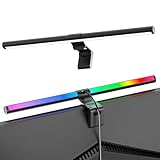

How the seven were screened and weighted
I weighted four things, in this order, and the order matters more than the individual scores.
- Glare control. A programmer stares at high-contrast text for hours. Any light that reflects off the panel is worse than no light. I gave the most weight to an asymmetric beam claim with a stated angle.
- Colour rendering. Syntax highlighting is colour-coded. A low-CRI bar shifts those hues. Ra95 and above scored; a listing with no published figure did not.
- Brightness control. Stepless dimming beats fixed steps, and an ambient sensor beats stepless dimming, because it removes the decision entirely.
- Fit. Length and mount type against real monitor sizes.
Why that order? Glare is the failure that makes people unplug the thing after a week. Colour rendering is the one you never notice going wrong. Brightness control is the one you interact with daily. Fit is binary, but it's easy to check before buying, so it ranked last.
Two of the seven publish an ambient light sensor. Four publish a CRI figure of Ra95 or better. Only one publishes both a sensor and Ra98, and that is the winner. Three carry no published weight at all, which is a real gap when you're clipping something to a thin monitor bezel.
Does a monitor light bar actually help programmers?
Here's the honest answer. The search for the best ergonomic monitor light bar for programmers returns general-purpose desk lighting, and none of these seven listings publishes a specification aimed at code specifically. Only the METCLARINDA even uses the word programmers, and it does so in the same breath as students and painters, which tells you it's marketing copy rather than a design brief.
So judge it on the mechanism, not the label. A light bar solves one problem: your desk is darker than your screen. That contrast forces your pupils to keep adjusting between the bright panel and the dim keyboard, notes and coffee cup around it. Fix the surround brightness and the adjusting stops.
Where it genuinely helps a developer:
- Reading a printed spec or a sticky note without turning on an overhead light
- Touch-typing sessions on an unlit mechanical keyboard
- Late evening work where a ceiling light bounces off a glossy panel
- Dual-screen setups where one panel sits in the shadow of the other
Where it does nothing: eye strain caused by small fonts, a bad refresh rate, or twelve straight hours without looking away. No lamp fixes those.
1. Quntis Computer Monitor Lamp — Best overall
The only pick here that pairs an ambient sensor with an Ra98 rendering claim, which is why it's the default recommendation.
Best for: long coding sessions in a dim room where you don't want to think about brightness Skip it if: your monitor is wider than 34 inches and you want edge-to-edge coverage
The specification that separates this one is the auto-dimming target. Quntis says a built-in ambient light sensor tracks the room and holds the illuminated area at 900 lux. Compare that to the fixed-step alternatives in this set: you adjust those manually every time the afternoon light changes, and most people stop bothering. Colour rendering is claimed at Ra98 across 78 LED beads, the highest published figure of the seven, which matters when your editor theme leans on subtle colour differences between variable types.
The body is 0.79 x 16.1 x 0.79 in and 1.1 lb, so it's slim enough to sit above a bezel without blocking the top row of pixels. Quntis also cites IEC/TR 62778 and IEC/EN 62471 certification for blue light and flicker, and an asymmetric optical design that throws light down onto the desk rather than back at the screen. Touch control handles on, off and stepless dimming.
The trade-offs are real. It's the joint most expensive tier in this group, only one seller lists it, and at 40cm it's built for standard panels rather than ultrawides.
Pros:
- Highest published rendering claim here at Ra98
- Ambient sensor targets 900 lux automatically
- Named blue light and flicker certifications
- Slim 0.79 in depth clears most bezels
- Published weight of 1.1 lb
Cons:
- Premium price position in this set
- Only one seller lists it
- 40cm span too short for a 34-inch ultrawide
- No RGB backlight if you want ambient colour
2. YEELIGHT Monitor Light Bar — Best for pros
A full-metal body and a published 250LM output make this the pick for anyone whose desk appears on camera.

Best for: developers who also run stand-ups, screen shares or streams from the same desk Skip it if: you want a colour-changing backlight behind the monitor
This is the value pick with pro specifications. It sits in the cheapest tier of the seven, yet it publishes a 250LM output figure and an Ra95 rendering claim, and YEELIGHT describes a full-metal housing rather than plastic. It's also the second-fastest seller in this group. At 41cm it's the longest of the standard-width bars here, edging past the winner's 40cm.
The dimensions read 3.07 x 2.64 x 17.6 in, and weight is 1.1 lb, matching the Quntis. YEELIGHT specifically calls the design camera-friendly, which in practice means the mount doesn't intrude into a webcam frame the way a bulkier counterweight can. Stepless dimming and adjustable colour temperature are handled by touch, and the listing confirms compatibility with both flat and curved monitors. Model number is YLYTD-0037, with a stated one-year warranty.
Against the winner it loses on two counts: no ambient light sensor, so you're dimming it yourself, and Ra95 rather than Ra98. Both are small gaps. If you'd rather spend less and adjust manually, this is the smarter buy.
Pros:
- Longest standard bar here at 41cm
- Published 250LM output figure
- Ra95 rendering claim
- Full-metal body per the listing
- Cheapest tier despite the specifications
Cons:
- No ambient light sensor
- Ra95 sits below the winner's Ra98
- No RGB backlight option
- Only one seller lists it
3. Quntis Curved Monitor Light Bar 15 RGB Backlight for 34"+ — Best premium
Extends to 26 in and is the only pick built specifically for curved panels over 34 inches.

Best for: anyone running a 34-inch or wider curved ultrawide Skip it if: your monitor is a standard 24 or 27 inch panel, where it will overhang
If you've bought an ultrawide, most light bars leave the outer thirds of your desk in shadow. This one extends up to 26 in and Quntis states compatibility with 800R to 3000R curvature, so it follows the bend instead of floating away from the bezel at each end. That single specification is the reason it exists.
The design is a foldable dual bar, giving you two light directions rather than one fixed downward throw. Front lighting adjusts steplessly from 3000K to 6500K with four preset brightness levels, and there's a precision light sensor that shifts brightness with the room, the same automation logic as the winner. A 15-zone RGB backlight handles the ambient side.
It's the heaviest pick at 2.69 lb, with a footprint of 4 x 17.3 x 5.5 in, and it's the most expensive here. Two sellers stock it, more than most of this set. The listing publishes no CRI figure and no warranty term, which is a notable omission at this price position given cheaper picks state Ra95 and a year of coverage. On a 27-inch screen it's simply the wrong tool.
Pros:
- Extends to 26 in for ultrawide coverage
- Rated for 800R to 3000R curvature
- Foldable dual bar for two light angles
- Light sensor plus four brightness presets
- 15-zone RGB backlight included
Cons:
- No published CRI figure
- No stated warranty term
- Heaviest here at 2.69 lb
- Highest price position in this set
- Overkill and oversized on a 27-inch panel
4. Syrinx Monitor Light Bar with Backlight — Runner-up
Wave-to-toggle control means you never touch the bar, which is the small ergonomic win nobody else here offers.

Best for: keyboard-heavy desks where reaching up to press a touch pad shifts your monitor Skip it if: you need the widest possible spread across a large desk
Every other pick here wants you to tap the top of the bar. Syrinx uses a hand wave instead. That sounds like a gimmick until you've knocked a monitor half an inch out of alignment for the third time. It's the lightest bar in this group at 0.75 lb, listed elsewhere as 12 oz, and Syrinx says that low mass avoids marking bezel frames.
Colour rendering is claimed at Ra95 from 84 LED beads, the highest bead count of the standard-width picks. The beam is described as 45° asymmetric, casting light only on the desk with zero screen reflection even on glossy curved panels. Stated fit covers 17 to 34 inch flat and curved monitors, the broadest compatibility range published in this set. There's an RGB ambient backlight with three modes: static gradient, marquee and music rhythm. Warranty is one year manufacturer limited, model YG006.
Two things hold it back. It's the slowest seller of the seven by a wide margin, so there's less installed base to draw on. And at 16.7 in it's marginally shorter than both the Quntis and YEELIGHT while sitting in a higher price tier than the YEELIGHT.
Pros:
- Wave gesture control, unique in this set
- Lightest here at 0.75 lb
- 84 LED beads with Ra95 claim
- Stated fit from 17 to 34 inches
- Three RGB backlight modes
Cons:
- Slowest seller of the seven
- Premium tier despite shorter bar than cheaper picks
- No published lux or lumen figure
- RGB backlight only on the RGB model variant
5. SAMPHON RGB Monitor Light Bar — Best for beginners
Nine RGB backlight modes and three front colour settings for the second-lowest price here, which makes it the low-risk first buy.
Best for: a first light bar on a desk that switches between work and gaming Skip it if: you want published weight and brightness figures before you commit
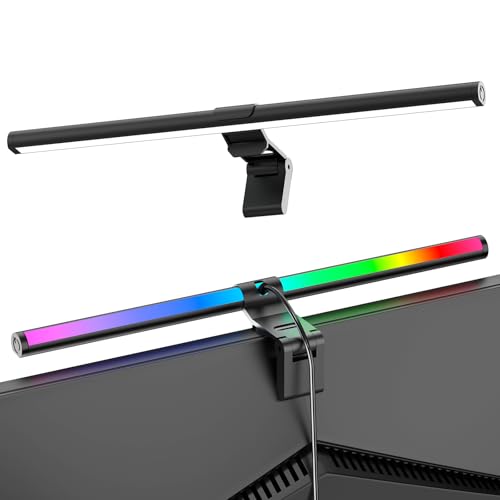
If you've never used one and don't know whether you'll like it, buy at the cheap end and find out. This SAMPHON is 15.8 in long with a 3.15 x 15.8 x 0.78 in footprint, and it splits into two lighting systems: a front bar with three colour settings and a rear backlight running nine RGB effects. Dual controls handle each independently, so the work light and the mood light don't fight.
SAMPHON states a 45° beam angle that puts light on the desk and screen rather than into your eyes, the same optical principle the pricier picks use. Power is USB-C, which is the only USB-C connection stated across these seven listings and a genuine convenience if your monitor has a spare C port. The mount is a retractable clip with a soft silicone pad, described as universal, and warranty is one year. Model SC03.
The gaps are informational. No published weight, no lux or lumen figure, no CRI number. For a first purchase that's tolerable; if you want to compare rendering accuracy against the Quntis, the data isn't there.
Pros:
- Second-cheapest of the seven
- Nine RGB backlight effects plus three front colours
- USB-C power, the only one here
- Silicone-padded retractable clip
- Independent dual controls
Cons:
- No published CRI figure
- No stated weight or brightness value
- 15.8 in is short for a 32-inch monitor
- Only one seller lists it
6. METCLARINDA Curved Monitor Light Bar with RGB Backlight — Best for heavy use
At 22 in it's the longest fixed-length bar here, covering desk width that shorter picks leave dark.

Best for: wide desks where a 16-inch bar leaves the keyboard edges in shadow Skip it if: warranty length is part of your buying decision
Span is the whole argument for this one. The dimensions are 0.7 x 22 x 1.1 in, which is 22 inches of illuminated length against 16.1 for the winner and 11.8 for the budget pick. On a deep desk with a keyboard, a notepad and a second input device, that extra reach is the difference between lit and half-lit. It's also the slimmest profile here at 0.7 in deep.
Controls are touch buttons covering three colour temperatures and stepless brightness. Five RGB backlights sit behind the screen, and a built-in mic drives a music sync mode that pulses the colour to audio. METCLARINDA mentions UL standard chargers and calls the output soft and comfortable for reading and creative work. Model DPML05501.
Two things need flagging. The stated warranty is one month manufacturer, by far the shortest of these seven, where five of the others publish a full year. And it's the slowest-moving product of the group. There's no published CRI, no lux figure and no weight. You're buying length and accepting thin documentation to get it.
Pros:
- Longest fixed bar here at 22 in
- Slimmest depth at 0.7 in
- Five RGB backlights with music sync
- Three colour temperatures plus stepless dimming
- Mid-range price for the extra length
Cons:
- One month stated warranty, shortest in this set
- Slowest-moving pick of the seven
- No published CRI, lux or weight
- Music sync mic may pick up keyboard noise
7. Samphon Monitor Light Bar — Best budget pick
The cheapest of the seven, and the only one publishing both a lux figure and a coverage area.
Best for: a small desk, a laptop dock, or a second monitor that just needs some light Skip it if: your primary monitor is 27 inches or wider
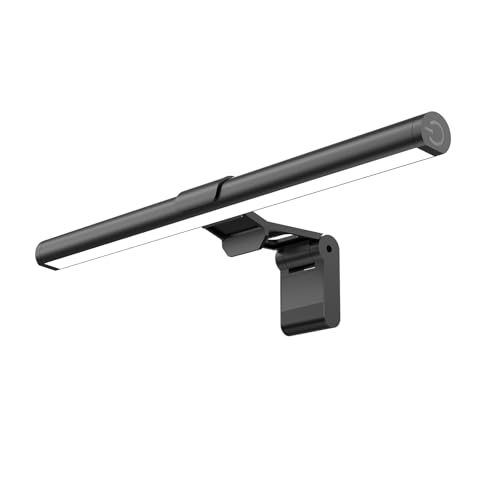
Short bar, clear numbers, lowest price. Samphon publishes 800 lux central brightness across a 30 x 20 inch coverage area, which is more specific than most listings here manage. It's the only pick besides the winner to state a target lux value, and that makes it easy to judge against your room.
Length is 11.8 in with a footprint of 3.3 x 11.8 x 0.78 in. Three colour temperatures are on offer at 3000K, 4000K and 6500K, with stepless brightness and a memory function that recalls your last setting through an on/off switch. That memory is a small but real ergonomic detail: no re-dialling every morning. The beam is stated at 45°, aimed at desk and screen only. Mounting uses a patented counterweight clip that Samphon says installs tool-free on thin and thick bezels alike. USB power works from a computer, adapter or power bank. Model SC02, one year warranty.
The honest limitation is span. At 11.8 in it's the shortest here by nearly five inches, and on a 27-inch or 32-inch panel it lights a pool rather than a strip. No published CRI figure either.
Pros:
- Cheapest of the seven
- Publishes 800 lux over 30 x 20 in
- Brightness memory function
- Three named colour temperatures
- Tool-free counterweight clip
Cons:
- Shortest bar here at 11.8 in
- No published CRI figure
- No stated weight
- Coverage thin on a 27-inch or larger screen
Will it fit your monitor and your desk?
Measure before you buy. Two numbers decide it: your panel's width and its bezel thickness.
Bar length against screen size, using the published figures:
- 24 inch flat panel: the 11.8 in Samphon or the 15.8 in SAMPHON RGB both work
- 27 inch flat panel: 16 in and up, so the Quntis at 16.1 in, the Syrinx at 16.7 in or the YEELIGHT at 17.6 in
- 32 inch flat panel: the METCLARINDA at 22 in
- 34 inch and wider curved: the Quntis ScreenLinear, which extends to 26 in and is rated for 800R to 3000R
Bezel and mount matter too. Every one of these seven uses a clip that hangs over the top edge, and the depth figures tell you how far forward the assembly sits: 0.7 in for the METCLARINDA at the slim end, 5.5 in for the curved Quntis at the bulky end. If a webcam already sits on your bezel, the slimmer bodies leave room.
One more thing shoppers miss: desk depth. A 45° downward beam covers roughly the area in front of the screen, not the whole desk. Samphon puts a number on it at 30 x 20 in. If your desk is deeper than that, expect the far corners to stay dark whichever bar you choose.
What more money buys in this set
Across these seven, price maps onto three things and nothing else.
At the cheap end you get the light and the beam angle. The Samphon and the SAMPHON RGB both publish a 45° asymmetric beam, and the Samphon states 800 lux. What you don't get is a CRI figure, a published weight, or automation. The YEELIGHT is the anomaly: cheapest tier, but with Ra95, 250LM and a metal body.
In the middle you buy length. The METCLARINDA's 22 in span is the practical thing money adds there, along with five RGB zones and music sync. Documentation stays thin and the stated warranty drops to one month.
At the top you buy automation and reach. The winning Quntis adds the ambient sensor holding 900 lux, Ra98 rendering, and named IEC certifications. The curved Quntis adds 26 in of extendable span and dual-angle folding. The Syrinx adds wave control and the lightest body at 0.75 lb.
So the honest read: spending more on the best ergonomic monitor light bar for programmers buys you the sensor, the certification paperwork and the higher rendering figure. It does not reliably buy you a longer bar, since the mid-tier METCLARINDA out-spans both premium Quntis models in fixed length.
What the listings do not tell you
Four gaps are worth knowing before you click.
None of these seven publishes a power draw figure. All are USB powered, and only the SAMPHON RGB specifies USB-C, so check what port you're feeding it from and whether your monitor's USB hub stays live when the screen sleeps. A bar plugged into a sleeping hub goes dark with it.
None publishes a colour temperature accuracy tolerance. Three name a 3000K to 6500K range, but a claimed 4000K setting and a measured one are different things.
Only two publish a lux target. The rest describe brightness in adjectives. If you care about matching your surround brightness to your panel, the Quntis at 900 lux and the Samphon at 800 lux are the only ones giving you a starting point.
And no listing here states cable length. On a desk where the USB source is behind a monitor arm, that's a genuine unknown. Plan on needing an extension.
The verdict
Three tiers, three answers.
Entry tier. The YEELIGHT Monitor Light Bar is the outright value winner of this group. Cheapest tier, 41cm of length, an Ra95 claim, a 250LM figure and a metal body. If you only want one recommendation and you don't want to spend up, buy this. The Samphon at 11.8 in is the pick when the desk is genuinely small or the bar is going on a secondary screen.
Middle tier. The METCLARINDA earns its place on span alone at 22 in, with five RGB zones thrown in. Accept the one-month stated warranty and thin specification sheet as the price of that length.
Premium tier. The Quntis Computer Monitor Lamp is the overall winner and the best ergonomic monitor light bar for programmers in this set, because the ambient sensor holding 900 lux plus the Ra98 claim and the IEC certifications is a combination nothing else here matches. The cutoff that flips it: a monitor wider than 34 inches. Past that threshold the Quntis ScreenLinear's 26 in extension and 800R to 3000R curvature rating make it the only sensible choice, even though it publishes no CRI figure. The Syrinx takes it if wave control genuinely appeals, which it does on cramped desks.
FAQ
Is a monitor light bar worth it for a programmer?
A monitor light bar is worth it for a programmer whose desk is darker than the screen, which describes most evening and late-night setups. It removes the pupil adjustment between a bright panel and a dim keyboard. It does nothing for strain caused by small fonts or long unbroken sessions, so treat it as one fix among several rather than the whole answer.
What is the best ergonomic monitor light bar for programmers on a budget?
The best ergonomic monitor light bar for programmers on a budget is the YEELIGHT, not the cheapest one. It sits in the entry price tier while publishing an Ra95 rendering claim, a 250LM output and a full-metal body across 41cm of length. The Samphon costs less still at 11.8 in, but it publishes no CRI figure and covers a smaller area.
Quntis Computer Monitor Lamp or YEELIGHT: which should I choose?
Choose the Quntis Computer Monitor Lamp if you want the ambient sensor that holds 900 lux without input and the higher Ra98 rendering claim. Choose the YEELIGHT if you'd rather pay entry-tier money, dim it manually, and accept Ra95. The YEELIGHT is also 41cm against the Quntis 40cm, and it publishes a 250LM output figure the Quntis does not.
Will a monitor light bar fit a curved ultrawide screen?
A monitor light bar will fit a curved ultrawide only if it's built for one. The Quntis ScreenLinear extends to 26 in and states compatibility with 800R to 3000R curvature. The Syrinx publishes a 17 to 34 inch flat and curved range. A rigid 16 in bar on a 34-inch curve leaves both ends lifted off the bezel.
What mistake do people make buying a monitor light bar?
The mistake people make buying a monitor light bar is picking on brightness instead of beam angle and bar length. A bright bar with a symmetric beam reflects straight off a glossy panel and makes text harder to read. Six of these seven publish a 45° asymmetric beam claim for that reason. Then check length against your screen width.
Start by measuring your monitor's width, then match it against the length column in the table above. That one number eliminates most of this list before you compare anything else. If you land on a 27-inch panel, which most developers do, the Quntis Computer Monitor Lamp at 16.1 in is the pick, and the sensor holding 900 lux means it's the only one you'll stop thinking about after the first week. Good lighting hardware is the kind you forget you installed. That's the whole point.